Breastfeeding For Flat Or Sunken Nipples
 Author: Maryam Ayres
Time for reading: ~5
minutes
Last Updated:
August 08, 2022
Author: Maryam Ayres
Time for reading: ~5
minutes
Last Updated:
August 08, 2022
CHAPTERS (Table Of Contents)
There are some anatomical features in the size and shape of the nipples that make breastfeeding difficult.
There are some anatomical features in the size and shape of the nipples that make breastfeeding difficult. Most nipples are perfectly shaped to fit in a baby's mouth, but some small, flat, or sunken (inward-facing) nipples make this process difficult and make breastfeeding more challenging because the baby has trouble breastfeeding and twisting. In order for the baby to suckle effectively, he must be able to stretch the nipple forward and up to his palate. As a result of improper breastfeeding, milk production may be reduced and the baby may not receive enough milk.
If you have this problem, do not rush to worry. With proper care and diligence, you can breastfeed even if your nipples are flat or inverted.
How do you know if your nipples are flat or sunken?
To find out what type of grains you have, you can do a simple test. Just place your fingers (thumb and forefinger) on the edge of the areola (the colored part of the breast) and press lightly. In case the nipple of the breast protrudes, then you have nothing to worry about. Flat grains do not stand out much from the surrounding space (areola) and do not go out when stimulated or exposed to cold. In principle, they should not be a problem unless your baby is breastfeeding well or your breasts are full.
On the other hand, if the nipple retracts and resembles a dimple, then you have sunken (inverted) nipples.
If you are unsure of your judgment, you can consult a doctor - he will provide you with information about the condition of your nipples. The good news is that the appearance of the nipples in no way affects the production of milk and its release.
Because the breasts function independently of each other, it is not uncommon for a woman to have a flat or sunken nipple and a normally protruding nipple. For the same reason, it is not uncommon for one breast to produce more milk than the other.
What can you do if you have flat or sunken nipples?
Most opinions suggest that you do not need to do anything in advance, as you may not have a problem with breastfeeding.
However, some women need a little help. If you have a problem with the nipples, you can prepare for breastfeeding by inserting silicone discs with a central hole (nipple correctors) in the bra. The constant pressure on the nipple helps to gradually shape it out through the opening of the disc. For years, these discs have been recommended for use in the last months of pregnancy. However, studies show that no significant change in the shape of the nipple is found, in addition, they can cause sweating and rashes on the breasts. For this reason, they are rarely recommended for use and only in the periods between feedings of the baby.
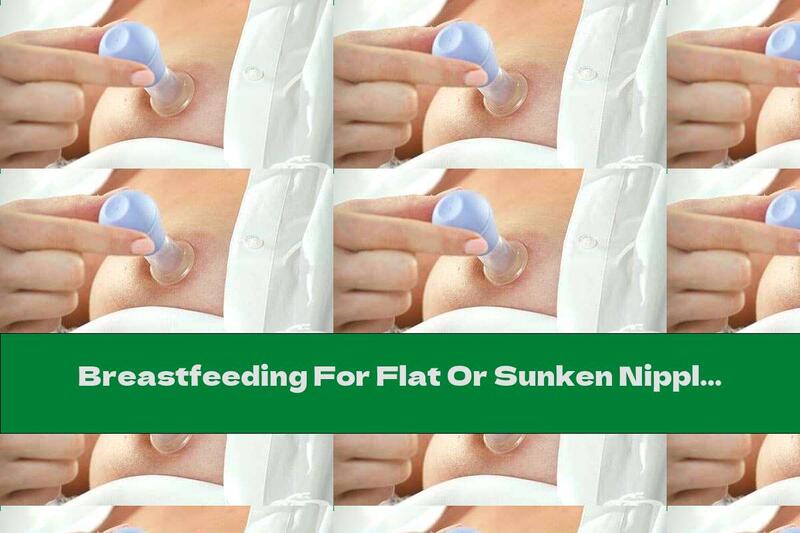
There are other types of nipple concealers that look like small, silicone cups with tubes attached to them. The silicone cups are placed on the nipples, and a syringe is attached to the tubes to draw air. In this way the nipple is sucked out towards the cup. If you use this type of concealer for only a few weeks of use, you can have quite good results.
Another option for preparing the nipples is with the help of the breast pump just before placing the baby on the breast. It can also be useful in the presence of subcutaneous adhesions in the nipple. If both nipples are very sunken (which is usually NOT the case), it may be necessary to use a double pump every 2-3 hours until the adhesions are removed and the nipples begin to protrude. Usually only one grain is sunken. In this case, you can breastfeed the baby on the other breast, and with the pump you can express the one with the problem nipple.
In some mothers, sunken nipples may protrude with a single pump, while in others they have to use the pump for days, weeks and even months depending on the degree of inversion (inversion) of the nipple.
Hoffman's technique can also be used for adhesions at the base of the nipple - place the thumbs of both hands against each other at the base of the nipple and pull the thumbs apart with light movements. You can repeat this exercise up to twice a day at the beginning and gradually increase to five times a day.
If you have a problem with the shape of the nipples, it is good to seek help from a breastfeeding consultant (or an experienced breastfeeding woman), especially on the first attempts, as they are the most problematic. Breastfeeding counselors can suggest some useful techniques such as:
- Nipple Stimulation - Grasp the nipple between your thumb and forefinger and rub lightly for about 30 seconds, then touch with a damp, cold towel before offering the breast to your baby.
- Pulling the areola before twisting by the baby - take your breast with the thumb on top and the other fingers on the bottom. Pull the breast to the chest wall. This will help the nipple to stand out.
- Use of nipple protectors - these are silicone guards with holes at the end (resembling a pacifier), which are placed on the nipples to help painful breastfeeding and prevent irritation and cracking of the nipples. Don't use them if you really don't need them! Avoid them during breastfeeding training, when the baby is learning to suckle, as there is a significant difference between sucking directly from the breast and sucking from a silicone guard. For some babies who are breastfed for a long time with nipple protectors, it is difficult, and in some cases impossible, to refuse.
More information on the use of silicone nipple protectors and other breastfeeding difficulties can be found in the topic " Breastfeeding for sore, cracked and bleeding nipples ".
During the first attempts at breastfeeding in healthy, full-term and energetically suckling babies who open their mouths wide enough when breastfeeding, flat and sunken nipples may not be a problem.
Overfilling of the breasts (especially 2-5 days after birth), when milk production increases, leads to smoothing of the nipples. This can lead to a problem with the baby twisting. To avoid this problem, breastfeed your baby often or express milk using the breast pump.
Related Articles
- The Ultimate Guide to Flatizza: Benefits, Recipes, and Nutrition
- Nutrition Guide: Breastfeeding for Infants and Mothers
- The Benefits of Night Breastfeeding for Nutrition: A Complete Guide
- The Importance of Night Breastfeeding for Nutrition: Benefits for Your Baby
- The Ultimate Guide to Flatizzas: Nutrition, Recipes, and More
Top Nutrition Articles Today
- . Melanin In Foods: What It Is Responsible For And How To Incr...
- . The Role of Amylase in Nutrition: Importance, Function, and...
- . The Impact of Coca-Cola on Nutrition: Caloric Content, Blood...
- . The Role of Water in Nutrition: Importance of Hydration and...
- . The 45-30-25 Diet: A Balanced Approach to Nutrition
- . Hydrochloric Acid in Digestion: Importance, Symptoms, and Su...
- . The Nutritional Benefits of Fish Roe: A Superfood for Your H...
- . The Role of E220 in Nutrition: Preservative, Color Retention...
- . The Ultimate Guide to Carbs in Nutrition: Types, Diets, and...
- . The Science of Raising Agents in Baking: Chemical and Functi...